
Offset Rising Utility Costs. Free Up Your Team.
Livable automates utility billing, RUBS, and cost recovery — so rising utility rates don't eat your NOI.
- 30%
- Average reduced consumption amount
- $1M+
- Value created on a 100-unit, $12M property
- 60 Days
- First bill back timeline
- 85%
- Of utility costs recoverable via RUBS
Trusted By





Why Livable
From Chaos to Control: A Better Way to Manage Utilities
Livable brings bill ingestion, cost allocation, resident billing, and support into one clearer utility administration workflow.
AI-Powered Billing
Your team stops chasing bills. Livable handles bill acquisition and intake automatically so nothing falls through the cracks.
Dynamic Cost Recovery
You choose the allocation method: occupancy, square footage, sub-metered usage, or custom. Self-service or fully automated.
Resident Transparency & Conservation
Give residents a dedicated portal for statements, billing and allocation details, and enable payment through Livable or sync charges directly into your property management system.
2026 Utility Outlook
Get the 2026 Utility Rate Report
See where water and sewer costs are rising and what that could mean for your property budgets, billing strategy, and recovery planning. Enter your work email to get the report.
Solutions
The core of Livable’s utility workflow: from operations to cost recovery to billing
Utility Billing & Cost Recovery
Recover shared utility costs with clearer allocation and less revenue leakage.
Property Manager Dashboard
Review charges and billing activity without disconnected spreadsheets or manual handoff.
Tenant Connect
Give residents one place to view statements, pay online, and stay current on utility activity.
Portal experiences
Two portals, one connected utility workflow.
Explore the PM Portal
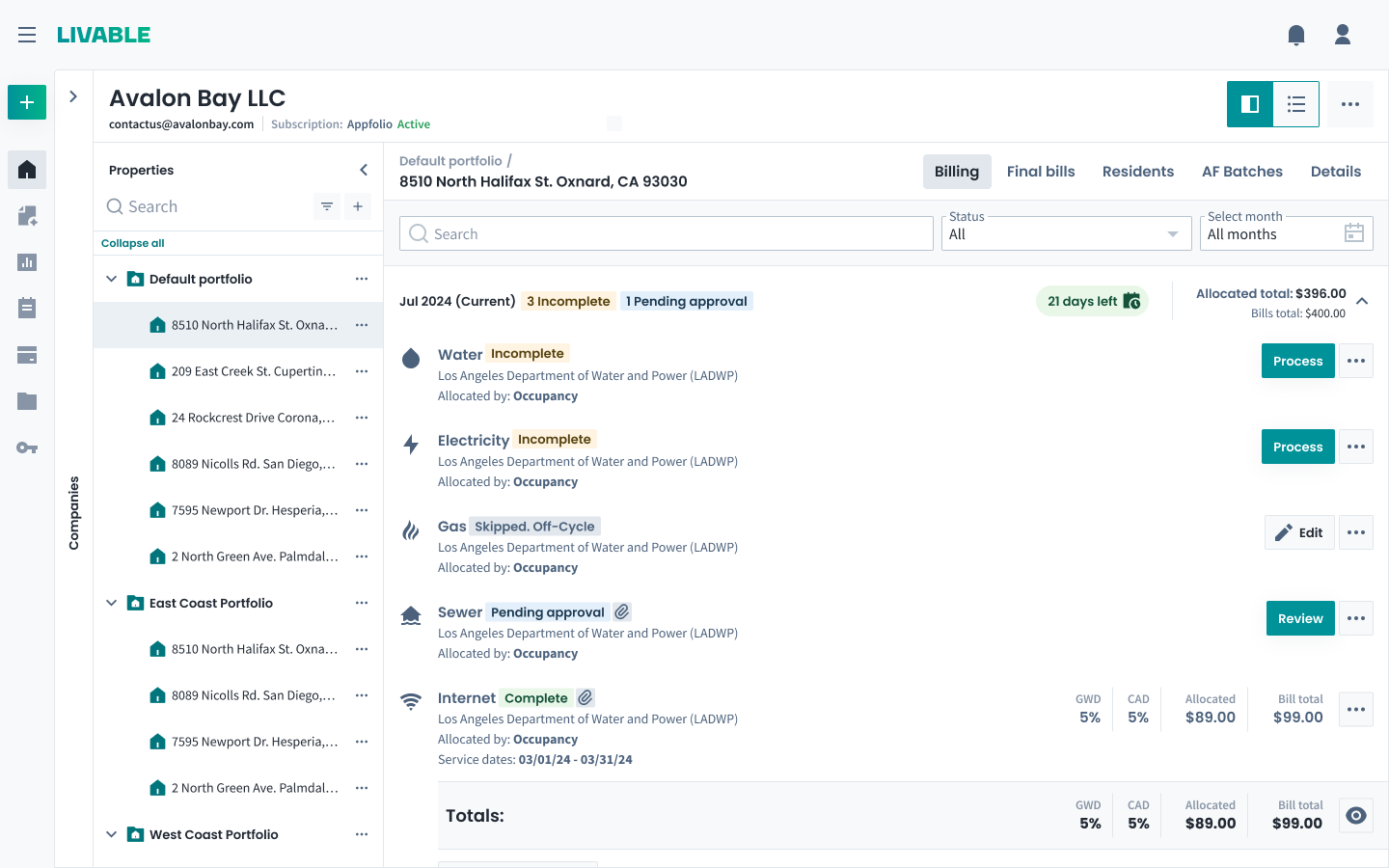
Review utility activity, modify billing details, approve charges, and keep portfolio recovery visible without spreadsheet handoffs.
Explore the Tenant Portal
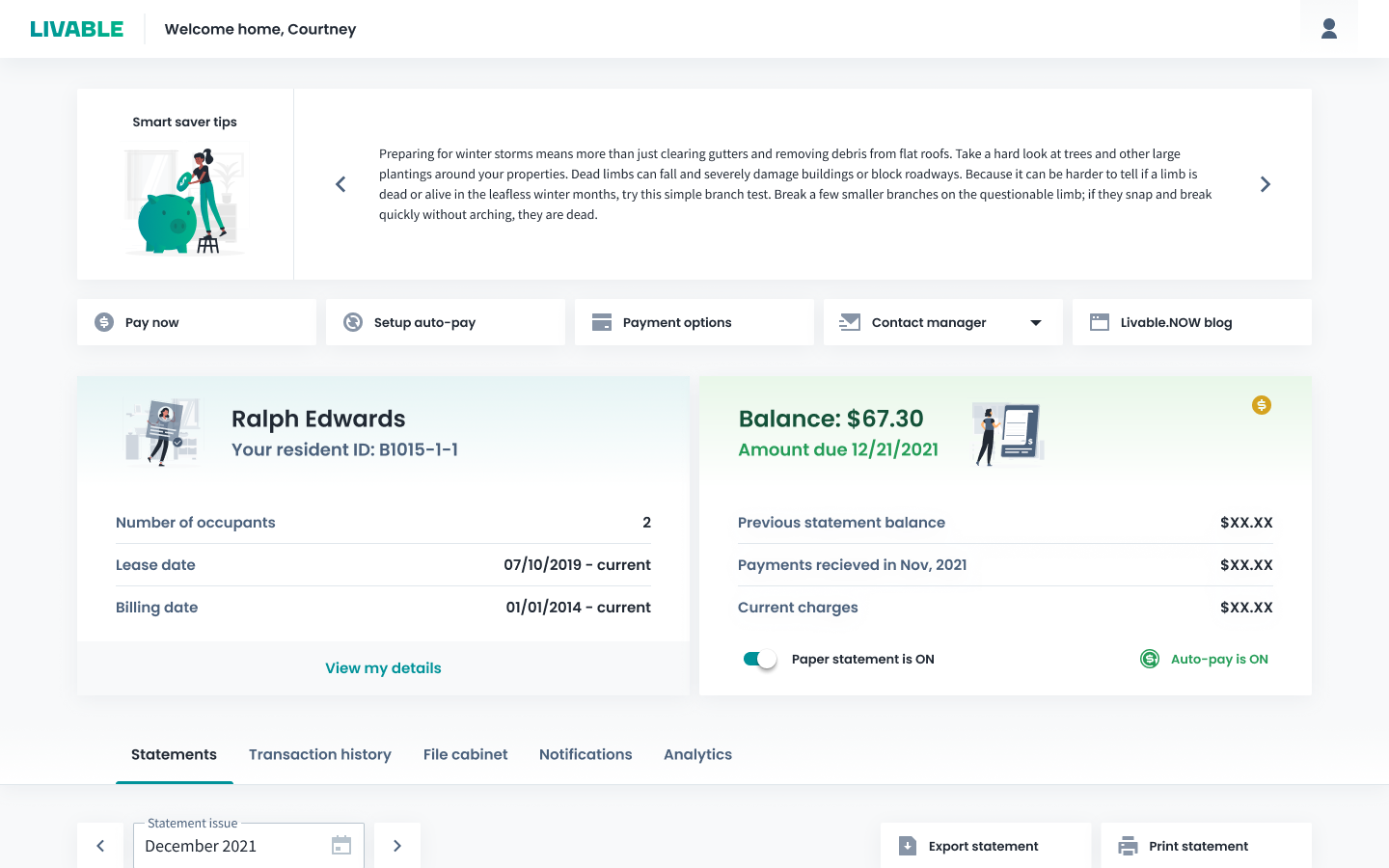
Give residents a transparent place to view statements, understand charges, pay online, and get support in the language they need.
Billing options
You have options.
Self Service
Bring billing in-house. Full control, less overhead, your process from start to finish, guided by our system.
- Allocation table generation, preview & charge approval
- Custom Tenant fees & utility opt-outs
- Utility & statement caps
- Final Statement Estimation (w/ daily proration)
Bill Automation
Delegate your billing to Livable. We take it from acquisition to resident statement — fully automated, fully managed. You stay in control with the ability to review, adjust, or override at any point.
- All features from Self-service
- Automatic data acquisition & entry
- Multi-lingual tenant support
- Spike alerts and billing adjustment management
3-Step Process
Setting Up Livable is Quick & Easy
Trusted by
Property Managers Nationwide
FAQ
Answers to the questions that usually show up before a consultation.
RUBS stands for Ratio Utility Billing System, a method used to fairly divide shared utility costs among residents in buildings without individual unit meters. Instead of absorbing the full utility bill, property managers use RUBS to allocate shared expenses based on measurable factors like occupancy, square footage, and in-unit amenities. Livable’s proprietary software handles the math by weighing the relevant factors for each unit, including resident count, unit size, and amenities like in-unit washers, then calculating each resident’s fair share automatically. The result is a transparent, defensible allocation residents can review in detail.
Yes, and Livable has been operating compliantly since 2009. RUBS is legal in most U.S. markets, though rules vary by state, county, city, and sometimes by utility provider. The important question is not only whether RUBS is allowed, but whether your program is administered correctly for your market. Livable’s legal team monitors ordinance requirements across the markets we serve, and our internal billing policies often exceed local requirements. We also maintain allocation tables, bill copies, and statement disclosures so your program remains transparent and defensible. Recent legislation such as Colorado HB26-1013, signed on March 26, 2026, further clarified RUBS as an authorized billing method in Colorado when requirements are met.
Yes. Livable is a certified AppFolio Stack Partner, and can also use AI-assisted workflows to support integration-like processes where a native connection is not available. For AppFolio users, Livable offers a native integration that syncs utility charges directly into the AppFolio workflow. Residents pay through AppFolio as part of their normal rent payment, with no separate portal required and no double entry for your team. Livable calculates the charges and pushes them directly into AppFolio for collection.
No, Livable is designed to reduce manual work. We handle the parts of utility administration that usually create the most overhead: acquiring utility bills, calculating allocations, generating resident statements, collecting payments, and answering resident billing questions. Your team can review and approve charges through the Property Manager dashboard, while Livable handles the operational heavy lifting. For teams that want fully hands-off billing, the Bill Automation tier handles the workflow end to end. For teams that prefer more control, the Self-Service tier automates data entry while keeping your team in the approval seat.
Livable supports every major allocation method, so your setup is not forced into a one-size-fits-all template. Shared utility costs can be allocated by occupancy, square footage, fixed percentage split, by unit, sub-metered usage, actual consumption, or custom weighting that combines multiple factors. In-unit amenities such as washers, dryers, and dishwashers can also be factored in because they meaningfully affect consumption. Every allocation is visible to residents through their portal, including a detailed breakdown of how their share was calculated.
It depends on how your property is set up, and Livable supports both paths. For properties using supported property management software, utility charges are synced directly into the system residents already use, so they pay as part of their existing rent payment without creating a separate account. For direct billing, residents receive statements and pay through the Livable Resident Portal by free ACH, debit card, or credit card, with Auto-Pay and multilingual support available. In both cases, residents can access a dedicated portal to view their statement, see how charges were calculated, and review the underlying utility bill.
Livable is built to handle resident questions directly, so your team does not have to manage the billing back-and-forth. Every resident statement includes a full allocation table showing how charges were calculated, along with access to the underlying utility bill, with sensitive information redacted when needed. This level of transparency resolves most questions before they become disputes. When residents do have questions, Livable’s support team handles them directly by phone and email Monday through Friday, with a 24/7 AI agent available on demand. In the rare case of a formal dispute, Livable provides documentation to support your position, including allocation methodology, bill copies, and statement history.
Most properties are up and running within a few weeks. The process starts with a free consultation where Livable reviews your property setup, utility mix, and billing goals to design the right configuration for your portfolio. Then we configure your properties, integrate with your property management software when applicable, and prepare your allocation tables. Once setup is complete, Livable either begins acquiring bills directly or trains your team on how to input them, then calculates allocations and generates resident statements automatically each cycle. There is no long implementation project; after a consultation, we can give you a realistic timeline based on your portfolio.
Latest Insights
Smart Water Sensors: How Property Managers Are Catching Leaks and Cutting Water Waste
From fixture-level meters to motion-activated toilet shutoffs, here's what's new in water technology for multifamily properties. Water is one of the hardest utilities to control in multifamily housing. Leaks run unnoticed behind walls and inside toilet tanks, and the bill arrives long after the water is gone. The cost adds up quietly. A worn toilet flapper or a dripping fixture rarely gets reported, so the waste only shows up on the master bill weeks later, after the water is already paid for. A new generation of smart water devices gives property managers better tools to see that waste, stop it, and bill for what's left fairly. Below, we break down the main options, and you can find exclusive discounts for Livable customers on our smart water solutions page .
Multifamily Heading Into Q4 2026: The Supply Wave Is Being Absorbed, but Pricing Power Hasn't Returned
For the past two years, the multifamily story has been about supply. Developers delivered a historic wave of new units, and operators across much of the country spent 2025 and 2026 competing for residents with concessions and flat rents. Heading into the fourth quarter, the data points to a market in transition. Vacancy is easing, concessions are reaching fewer units, and new construction has slowed sharply. But rents are still flat nationally, discounts remain unusually deep, and in many markets expenses are still rising faster than revenue. Here's what the latest numbers say, and what they mean for property managers and owners planning for the end of the year.
The Hidden Cost of Turnover: How Vacant Units Quietly Drain Your Utility Budget
Turnover gets measured in a lot of ways: lost rent, marketing spend, maintenance hours. One cost that rarely makes the spreadsheet is what happens to utilities while a unit sits empty.